



It’s one of the most common questions we hear at Scalvia, and it’s a fair one. Unlike paid advertising, where you can switch on a campaign and see clicks within minutes, SEO in Perth is a long-term strategy that focuses on building sustainable online visibility. It takes time to build strong rankings and authority, but it also keeps working long after the initial effort is done, helping businesses attract relevant organic traffic and achieve long-term growth.
In this guide, we’ll walk you through what SEO actually includes, how it works behind the scenes, and a realistic timeline for results. We’ll also cover where search is heading next, including Local SEO, Answer Engine Optimisation (AEO), Generative Engine Optimisation (GEO), and AI SEO, so you understand exactly what a modern, future-proof SEO strategy looks like.
What Does SEO Include?
Search Engine Optimisation is often misunderstood as simply “getting keywords onto a page.” In reality, a proper SEO strategy is made up of several moving parts that all need to work together:
- Technical SEO – ensuring your website is fast, secure, mobile-friendly, and easy for Google to crawl and index, including Core Web Vitals, site architecture, and crawlability.
- On-page optimisation – optimising your content, metadata, headings, internal linking, and page structure so search engines understand what each page is about.
- Keyword research – identifying the exact terms your potential customers are searching for, so your website targets the right traffic rather than guesswork.
- Content strategy – creating valuable, relevant content that answers real questions your customers are asking.
- Local SEO – optimising your Google Business Profile and website to attract customers searching in your specific city or suburb.
- Authority building – earning trust through ethical link-building and strengthening your website’s topical authority.
- Reporting and ongoing optimisation – tracking performance and refining the strategy month on month.
At Scalvia, every SEO campaign is built around these core pillars, tailored to your industry, your goals, and the competitive landscape you’re operating in, rather than a one-size-fits-all package.
How Does SEO Actually Work?
Google’s algorithm considers hundreds of ranking factors when deciding which websites appear on the first page of search results. In simple terms, the process looks like this:
- Crawling – Google’s bots discover your website and its pages.
- Indexing – your pages are stored in Google’s database once they’re understood and deemed valuable.
- Ranking – when someone searches, Google’s algorithm decides which indexed pages best match that search, based on relevance, authority, user experience, and hundreds of other signals.
SEO is the ongoing process of improving each of these stages: making your site easier to crawl, more relevant to index, and more deserving of a high ranking. Because Google is constantly refining its algorithm and your competitors are constantly optimising too, SEO isn’t a “set and forget” task. It’s a continuous strategy of improvement.
How Long Does SEO Really Take? A Realistic Timeline
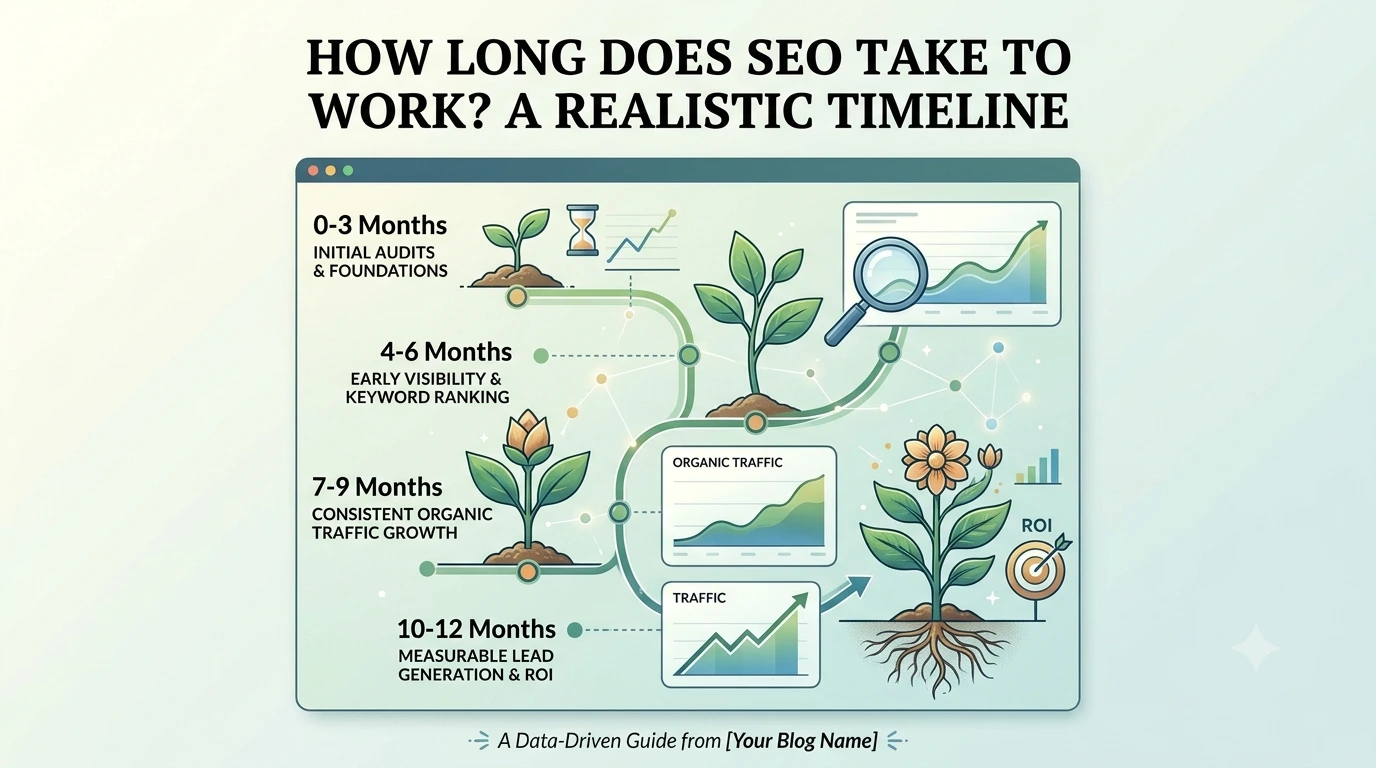
This is the part everyone wants to know, so let’s be upfront: there’s no universal number. Anyone who promises overnight rankings isn’t being honest with you. That said, based on what we typically see across Perth businesses, here’s a realistic breakdown.
Months 1 to 3: Foundation and Setup
This is the research and groundwork phase. It includes a full SEO audit, keyword research, technical fixes, on-page optimisation, and setting up (or optimising) your Google Business Profile. You may start to see small improvements in indexing and technical performance, but significant ranking movement is rare this early. This is the investment stage, not the payoff stage.
Months 3 to 6: Early Momentum
This is when most businesses start noticing meaningful change. Rankings for lower-competition keywords begin to climb, organic impressions and clicks in Google Search Console increase, and your website starts appearing for more relevant search terms. If you’re a local Perth business, this is often when Local SEO improvements start driving more calls and enquiries.
Months 6 to 12: Compounding Growth
By this stage, content, technical improvements, and authority-building efforts start compounding. Rankings for more competitive keywords improve, organic traffic becomes more consistent, and you start seeing SEO contribute real, trackable leads rather than isolated wins.
12+ Months: Sustainable, Long-Term Results
SEO is a long-term digital asset. Businesses that stay consistent typically see the most competitive keywords ranking well, a steady stream of organic enquiries, and a search presence that continues generating traffic without ongoing ad spend. Unlike paid advertising, this traffic doesn’t disappear the moment you pause your budget.
Factors That Influence Your SEO Timeline
Every business is different, and several factors affect how quickly you’ll see results:
- Website age and history – a brand-new website generally takes longer to build authority than an established one.
- Competition level – ranking for “plumber Perth” is far more competitive than a niche, low-volume search term.
- Current technical health – a website with significant technical issues needs those resolved before rankings can improve.
- Content quality and quantity – thin or outdated content slows progress; comprehensive, useful content speeds it up.
- Backlink profile – websites with little to no authority signals typically take longer to gain trust with Google.
- Consistency of investment – SEO rewards ongoing effort. Stop-start campaigns tend to lose momentum.
Local SEO: Getting Found by Perth Customers
For most Perth businesses, Local SEO is where results are felt fastest and most directly. When someone searches for a service “near me” or includes a suburb in their search, Google prioritises relevant businesses, close by and well-optimised locally.
Local SEO includes optimising your Google Business Profile, building consistent local citations, gathering genuine customer reviews, and creating location-relevant content. Whether you’re targeting customers across Perth CBD, Joondalup, Fremantle, Osborne Park, Subiaco, Canning Vale, Victoria Park, Morley, Balcatta or Rockingham, a well-executed local strategy helps your business appear in Google Search and Google Maps exactly when nearby customers are searching.
At Scalvia, Local SEO is built into every Perth SEO campaign because visibility in your own backyard is often where the most valuable, ready-to-buy customers are found.
Answer Engine Optimisation (AEO): Preparing for the Question Economy
Search behaviour is changing. More people are asking full questions rather than typing short keywords, whether through Google, voice assistants, or AI tools. Answer Engine Optimisation (AEO) is the practice of structuring your content so it directly and clearly answers these questions.
This includes writing content in a clear, structured format, using FAQ sections, headings that mirror real customer questions, and structured data (schema markup) that helps search engines understand exactly what your content is answering. The goal of AEO isn’t just to rank; it’s to become the answer, whether that appears as a featured snippet, a voice search result, or a highlighted response.
Generative Engine Optimisation (GEO): Showing Up in AI Overviews and AI Chatbots
Search results no longer come exclusively from a list of blue links. Google’s AI Overviews, along with AI tools like ChatGPT, Gemini and Perplexity, now generate summarised answers by pulling information from trusted websites. Generative Engine Optimisation (GEO) is the practice of optimising your content so it’s more likely to be understood, trusted and referenced by these generative AI systems.
This involves creating well-structured, factually accurate, authoritative content with clear headings and genuinely useful information, rather than thin or keyword-stuffed pages. Businesses that focus purely on traditional rankings while ignoring GEO risk becoming invisible in this fast-growing category of AI-generated search results.
AI SEO: Future-Proofing Your Search Strategy
AI SEO in Perth brings together traditional SEO, AEO, and GEO into one connected strategy built for how search is evolving. Rather than treating AI-driven search as a separate channel, it’s about ensuring your website performs strongly across all forms of search, whether that’s a traditional Google results page, an AI Overview, a voice assistant, or a generative AI chatbot response.
As search continues to evolve, an SEO strategy that only chases traditional rankings will fall behind. At Scalvia, our approach already accounts for this shift: we build content that answers real questions, strengthen topical authority, and optimise for both traditional search engines and modern AI-driven search platforms, so your business stays visible today and remains competitive as search keeps changing.
The Real Benefits of Investing in SEO
SEO consistently outperforms other channels over the long term for a few key reasons:
- Compounding value – unlike paid ads, organic rankings continue generating traffic without ongoing cost per click.
- Higher trust and credibility – studies consistently show users trust organic results more than paid advertisements.
- Qualified traffic – SEO attracts people actively searching for your products or services, not passive audiences.
- Better user experience – SEO improvements (speed, mobile usability, clear content) benefit every visitor, not just search engines.
- Long-term cost efficiency – while SEO requires patience, the cost per lead typically decreases significantly over time compared to paid campaigns.
- Stronger local presence – for Perth businesses, Local SEO builds ongoing visibility in Google Search and Google Maps within your community.
Why Partner with Scalvia for SEO in Perth
Since 2019, Scalvia has worked with Perth businesses across a wide range of industries, from local service businesses to growing eCommerce brands, helping them improve their search visibility through tailored, data-driven strategies. Rather than chasing short-term wins, every campaign is built on a proven process: discovery and business analysis, a comprehensive SEO audit and keyword research, on-page optimisation, technical SEO, authority building and Local SEO, followed by ongoing reporting and refinement.
We believe in transparency over jargon. You’ll always know what we’re working on, why it matters, and how your SEO campaign is tracking towards real business outcomes, not vanity metrics.
So, how long does SEO take to show results? In most cases, you can expect early signs of progress within three to six months, with more substantial, compounding growth building between six and twelve months and beyond. The timeline depends on your industry, competition, website history, and consistency of investment, but the businesses that commit to SEO as a long-term strategy are the ones that build a lasting competitive advantage.
If you’re ready to improve your search visibility and start attracting qualified traffic that turns into real enquiries, get in touch with the team at Scalvia for a free consultation. We’ll take the time to understand your business and recommend the right SEO strategy to help you grow with confidence.