





Introduction
If you’re comparing SEO services in Perth, one of the first questions you will probably ask is: how much does SEO cost?
The honest answer is that there isn’t one standard price.
A small local business with a five-page website may need a very different SEO strategy from an established ecommerce store, a professional services firm or a business competing in a highly competitive market. The amount of work involved, the condition of the website, the level of competition, the number of services and locations being targeted, and the type of SEO required can all affect the investment.
As a broad Perth market benchmark, published 2026 pricing information from Perth Digital Edge places ongoing SEO services at roughly $500 to $5,000+ per month, with different levels of work sitting across that range. That figure should be treated as a market reference rather than a universal price list.
This guide explains what you can reasonably expect to pay for SEO in Perth, what influences the cost, what should be included in a professional SEO service and how to tell whether a proposal offers genuine value.
Quick Answer: How Much Does SEO Cost in Perth?
There is no fixed Perth SEO price because every website and business has different requirements.
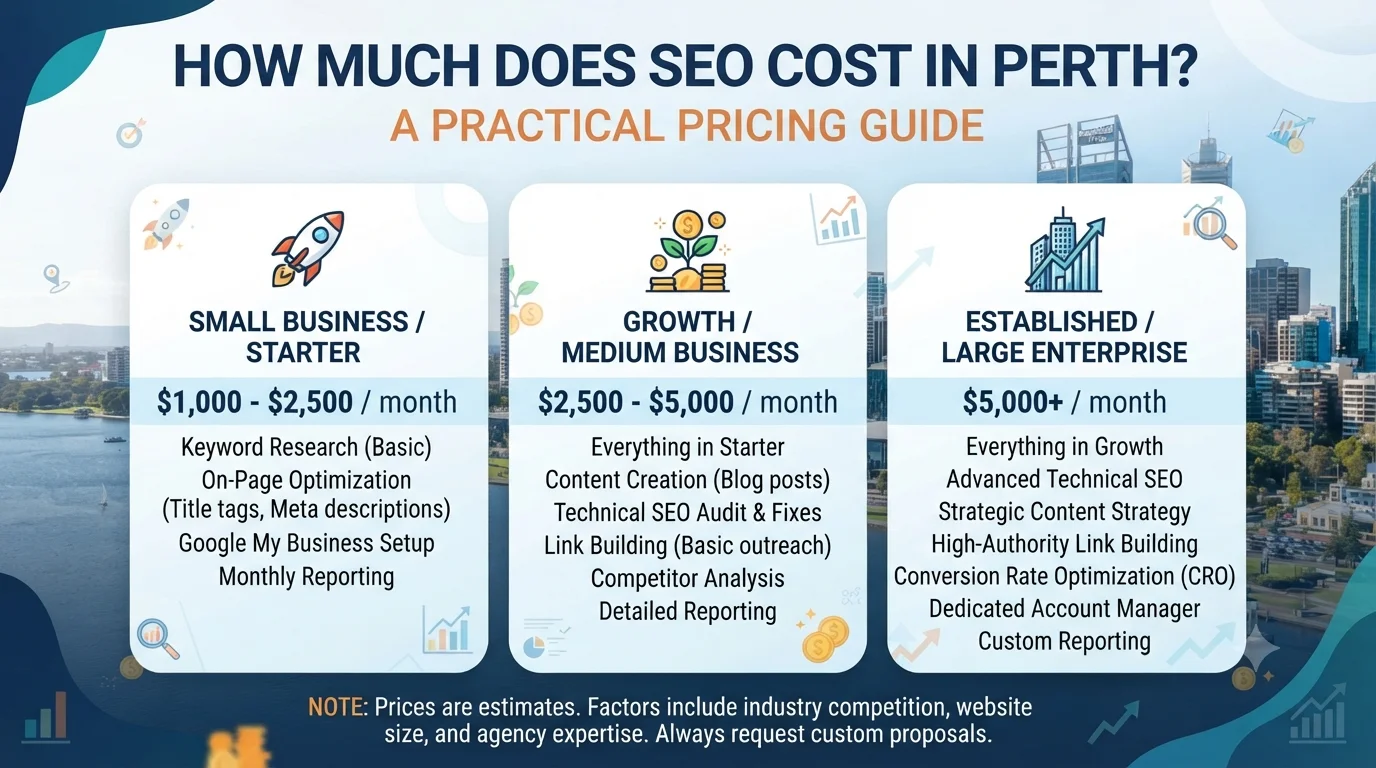
As a general market reference, ongoing SEO services can range from around $500 per month for more limited work to $5,000 or more for complex, competitive campaigns. The appropriate investment depends on the scope of work rather than the monthly figure alone.
A useful way to think about SEO pricing is:
| SEO investment level | Typical business situation | What may be involved |
|---|---|---|
| Lower investment | Small local business with limited competition | Basic technical work, on-page optimisation, keyword research and local SEO |
| Mid-range investment | Growing business with several services | Technical SEO, content, local SEO, internal linking and ongoing optimisation |
| Higher investment | Competitive industry, larger website or ecommerce | More extensive technical work, content production, authority building, testing and ongoing strategy |
| Bespoke | Complex or enterprise website | Custom technical, content, international, ecommerce or multi-location SEO |
These are planning categories, not fixed industry prices. A good SEO agency should assess your website before recommending a budget.
Why Does SEO Cost So Much?
SEO is often misunderstood as simply changing keywords on a website.
In reality, a professional SEO campaign can involve research, technical work, content, website structure, local search, competitor analysis, reporting and ongoing optimisation.
For example, an SEO specialist working with a Perth electrician might need to improve pages for:
- Electrician Perth
- emergency electrician
- residential electrical services
- switchboard upgrades
- electrical inspections
- specific service areas
An ecommerce business could require a completely different strategy involving hundreds or thousands of category and product pages.
That difference is one reason two businesses can receive very different SEO quotes.
The price should reflect the work required to achieve the business objective, rather than an arbitrary package name.
What Determines the Cost of SEO Services in Perth?
Several factors can influence how much an SEO campaign costs.
1. The Size of Your Website
A small brochure-style website may only have a handful of important pages.
A larger website can have:
- Hundreds of service pages
- Product categories
- Product pages
- Blog articles
- Location pages
- Filters
- Multiple templates
- Legacy URLs
More pages don’t automatically mean more SEO value, but they can increase the amount of work required to audit, optimise and maintain the website.
2. Your Industry and Competition
Competition has a major influence on strategy.
Ranking for a specific local service in a smaller market can be very different from competing for a highly commercial search term where established businesses already have strong websites and authority.
For example, the SEO requirements for a niche B2B manufacturer may be very different from those of:
- A law firm
- A mortgage broker
- An ecommerce store
- A dentist
- A real estate agency
- A large building company
A professional SEO provider should analyse the search landscape before deciding how much work is necessary.
3. Your Current Website Condition
An established website isn’t necessarily easier to optimise.
It may contain:
- Outdated content
- Broken links
- Duplicate pages
- Poor navigation
- Weak internal linking
- Indexing problems
- Slow templates
- Incorrect redirects
- Thin service pages
- Unclear page targeting
Google’s SEO documentation explains that technical requirements help Google access and index pages, but meeting those requirements alone doesn’t guarantee that a page will be indexed or rank well.
If your website has a weak technical foundation, some of the initial SEO budget may need to go towards fixing those problems before content expansion becomes a priority.
4. How Many Services You Want to Target
A business offering one primary service may require a relatively straightforward structure.
Another business might offer:
- Plumbing
- Gas fitting
- Hot water systems
- Drain cleaning
- Bathroom renovations
- Emergency services
Each commercially important service may need its own well-optimised page.
The more areas you want to compete for, the more research, content and optimisation may be required.
5. How Many Locations You Serve
Location also affects the scope.
A Perth business serving one area has different requirements from a company servicing:
- Perth CBD
- Joondalup
- Fremantle
- Midland
- Rockingham
- Canning Vale
- Osborne Park
- Subiaco
- Victoria Park
- surrounding metropolitan areas
However, creating dozens of nearly identical suburb pages isn’t necessarily a good strategy.
Location pages should exist where they genuinely help customers and provide useful, relevant information.
6. Content Requirements
Content is another major part of SEO investment.
A campaign may require:
- Service page improvements
- Blog articles
- Location pages
- Industry guides
- FAQs
- Comparison content
- Buying guides
- Supporting resources
Good content takes more than inserting a keyword into a template.
Google’s current guidance encourages helpful, reliable, people-first content that provides original value rather than content created primarily to attract search traffic.
That means a professional content strategy should focus on what potential customers actually need to know.
What Should Be Included in a Professional SEO Service?
Before comparing prices, find out what you’re actually buying.
A comprehensive SEO service may include the following.
Technical SEO
This can involve:
- Website crawling
- Indexing checks
- Broken links
- Redirects
- Canonicalisation
- XML sitemap review
- Robots.txt checks
- Website architecture
- Mobile usability
- Page performance
- Structured data
The exact technical work should be based on the website audit.
Keyword Research
Keyword research should identify more than high-volume phrases.
A good SEO specialist should look at:
- Search intent
- Commercial relevance
- Local searches
- Long-tail queries
- Service-specific searches
- Customer questions
- Competitor visibility
The objective is to identify searches that make sense for the business.
On-Page SEO
This may include:
- Page titles
- Meta descriptions
- Headings
- Content
- Image alt text
- Internal links
- URLs
- Search intent
- Content structure
The goal is to make each important page useful and clearly aligned with its intended search topic.
Local SEO
For many Perth businesses, local SEO is an important part of the strategy.
It can include:
- Google Business Profile
- Local landing pages
- Local search optimisation
- Business information consistency
- Citations
- Reviews
- Service areas
- Local content
- Google Maps visibility
A local SEO campaign should be tailored to the business rather than built from a generic checklist.
What Should You Get for Different SEO Budgets?
Rather than asking only, “How much does SEO cost?”, ask:
“What level of work can I realistically expect for my budget?”
That is a much better way to compare proposals.
Lower-Budget SEO
A smaller monthly investment may suit a small business with a relatively simple website and limited competition.
Potential priorities could include:
- Initial SEO audit
- Keyword research
- Basic technical improvements
- On-page optimisation
- Important service pages
- Local SEO fundamentals
- Basic reporting
The trade-off is usually scope.
There may simply not be enough time or resources to work extensively on technical SEO, content, authority building and multiple service areas at the same time.
Mid-Range SEO
A growing business may need a broader ongoing strategy.
Work could include:
- Technical SEO
- Keyword research
- Content optimisation
- New content
- Internal linking
- Local SEO
- Google Business Profile
- Competitor analysis
- Conversion recommendations
- Monthly reporting
This type of campaign can provide more room to work on several parts of the website at once.
Higher-Investment SEO
Larger websites and highly competitive industries may require significantly more resources.
The work may include:
- Extensive technical SEO
- Large-scale content development
- Ecommerce optimisation
- Digital PR or authority development
- Advanced internal linking
- Conversion optimisation
- Multiple locations
- Detailed competitor analysis
- Testing and iteration
- More frequent technical reviews
The higher investment isn’t valuable simply because the number is larger.
It should correspond to a larger or more complex scope of work.
Should You Choose the Cheapest SEO Agency?
Not necessarily.
A very low quote may look attractive, but you need to understand what the provider can realistically deliver.
Imagine two SEO proposals:
Agency A
$700 per month
- Basic reporting
- Limited optimisation
- Minimal content
- Little technical work
Agency B
$2,500 per month
- Technical SEO
- Content strategy
- New content
- Local SEO
- Internal linking
- Competitor analysis
- Conversion recommendations
- Detailed reporting
Agency B isn’t automatically better.
However, comparing the monthly prices without comparing the scope and quality of work doesn’t tell you much.
The right question is:
Which proposal gives your business the most appropriate work for its actual SEO needs?
What Should an SEO Proposal Include?
A professional proposal should make the scope reasonably clear.
Look for information about:
Strategy
- What are the main objectives?
- Which services or products are priorities?
- Which locations are being targeted?
Technical work
- What will be audited?
- What problems will be fixed?
- Who implements the changes?
Content
- How many pages will be improved?
- Will new articles be produced?
- Who writes and reviews the content?
Local SEO
- Is Google Business Profile included?
- Are local pages part of the strategy?
- How will local visibility be monitored?
Reporting
- What will be measured?
- How often will you receive reports?
- Will the report explain what changed and why?
Communication
- Who manages the account?
- How often can you discuss priorities?
- How are recommendations approved?
If a proposal simply says “SEO, backlinks, keywords and monthly report”, ask for more detail.
Monthly SEO vs One-Off SEO: What’s the Difference?
Some businesses need a one-off project.
Others need ongoing SEO.
One-Off SEO Work
This might include:
- SEO audit
- Website migration review
- Technical clean-up
- Keyword research
- Website structure recommendations
- Initial on-page optimisation
This can be useful when a business wants to establish a stronger foundation.
Ongoing SEO
Ongoing SEO allows an agency to:
- Monitor performance
- Publish and improve content
- Identify new opportunities
- Fix technical issues
- Strengthen internal linking
- Track competitors
- Improve existing pages
- Adjust strategy based on data
Google itself notes that changes can take different amounts of time to be reflected in Search, with some changes taking weeks or longer to assess.
That is one reason SEO shouldn’t normally be evaluated purely on a few days of movement.
How Long Should You Pay for SEO?
There is no universal minimum period that applies to every business.
However, SEO generally needs enough time for improvements to be implemented, crawled, indexed and assessed.
Google says some changes can be reflected within hours while others can take several months, and recommends allowing time to evaluate the impact of changes.
The more useful approach is to establish milestones.
For example:
Initial stage
- Audit the website
- Fix important technical issues
- Establish keyword priorities
- Improve key pages
Development stage
- Publish useful content
- Expand service coverage
- Improve internal linking
- Strengthen local visibility
Ongoing stage
- Measure performance
- Identify new opportunities
- Improve existing pages
- Test and refine the strategy
Does More Money Guarantee Better SEO Results?
No.
A larger budget gives an agency the ability to undertake more work, but spending more doesn’t automatically guarantee better rankings.
Google explicitly states that there are no secrets that automatically rank a site first.
The quality of the strategy matters.
So do:
- Website quality
- Competition
- Search intent
- Content usefulness
- Technical implementation
- Authority
- Business relevance
- User experience
A sensible SEO budget should therefore be based on the work your business needs, not on the assumption that a higher monthly fee guarantees a particular ranking.
What About Cheap SEO Packages?
Cheap SEO isn’t automatically bad.
A small business may genuinely need a relatively simple level of SEO support.
The problem comes when a low-cost package promises a large amount of work that realistically cannot be delivered within the available time and resources.
Watch for vague promises such as:
- Unlimited SEO
- Guaranteed #1 rankings
- Thousands of backlinks every month
- Instant results
- Guaranteed traffic
- Guaranteed leads
Be especially careful with guaranteed ranking claims.
Google’s own guidance says there is no way to guarantee a particular site’s inclusion or ranking in its organic results.
Why Extremely Cheap SEO Can Become Expensive
Suppose a business pays for SEO but receives little meaningful work.
After six or twelve months, the business may still need:
- Technical fixes
- Better content
- Improved service pages
- Local SEO
- Better internal linking
- A clearer website structure
The business hasn’t necessarily saved money.
It may simply have delayed the work.
This is why the scope of work and quality of execution matter more than the cheapest monthly quote.
Is SEO Worth Paying For?
SEO can be worthwhile when search engines are an important way your customers discover businesses like yours.
Consider a Perth service business.
A potential customer may search for a service, compare several websites and then contact one or two businesses for a quote.
If your website appears for relevant searches and provides a clear path to enquire, organic search can become an important part of the customer acquisition process.
However, SEO isn’t right for every business in every situation.
If your customers don’t use search to discover your product or service, or if you need immediate demand rather than longer-term visibility, other marketing channels may deserve more attention.
The right question isn’t:
“Is SEO always worth it?”
It is:
“Does organic search have enough commercial value for my business to justify investing in it?”
How Can You Measure the Value of SEO?
Avoid judging an SEO campaign entirely by keyword positions.
Look at a broader set of indicators.
Visibility
- Organic impressions
- Search queries
- Search visibility
- Relevant keyword coverage
Website performance
- Organic clicks
- Engaged visits
- Important landing-page performance
Business outcomes
- Phone calls
- Enquiries
- Quote requests
- Bookings
- Purchases
- Qualified leads
The right metrics depend on the business.
For example, a Perth plumber may care about phone calls and quote requests.
An online retailer may focus on organic transactions and revenue.
An accountant may care about consultation enquiries.
The reporting should reflect those differences.
Questions to Ask Before Hiring an SEO Agency in Perth
Before signing an agreement, ask these questions.
What exactly is included in the monthly fee?
You should understand what work is being performed.
Who will create the content?
Ask whether content is written internally, outsourced or generated through automation.
Will you fix technical SEO issues?
Find out whether the agency implements fixes or simply sends recommendations.
How do you measure success?
Look for business-relevant metrics rather than rankings alone.
Can you guarantee first-page rankings?
A reputable provider should explain why guaranteed rankings aren’t realistic.
What happens during the first three months?
You should have a clear idea of the initial priorities.
Can I access my website and analytics accounts?
You should retain appropriate access to your business assets.
How often will we review the strategy?
SEO should adapt when the market, website or business priorities change.
How Scalvia Can Approach SEO Investment
For Scalvia, the strongest approach is not to promote one universal SEO package for every Perth business.
Instead, the SEO strategy should begin with the business itself.
A local tradie may need strong service pages, local SEO and Google Business Profile optimisation.
A professional services firm may need service-led content, authority building and detailed educational resources.
An ecommerce store may need technical SEO, category optimisation, product architecture and content designed around commercial searches.
That means the investment should be linked to:
Business goals → Search demand → Competition → Website requirements → SEO workload → Measurement
This approach gives business owners a clearer understanding of what they are paying for.
What Makes SEO Good Value for Money?
Good SEO value isn’t necessarily about getting the lowest monthly price.
It comes from investing in work that has a clear purpose.
A worthwhile SEO campaign should:
- Focus on commercially relevant searches
- Improve the website itself
- Solve genuine technical problems
- Create useful content
- Strengthen important service pages
- Improve local visibility where appropriate
- Build a logical website structure
- Monitor performance
- Adapt to new opportunities
- Connect SEO activity with business goals
Google’s guidance similarly encourages website owners to create useful, reliable, people-first content and avoid producing large amounts of content simply to attract search traffic.
SEO Pricing in Perth: A Practical Way to Think About Your Budget
Instead of starting with a number, start with the questions below.
If you’re a small local business
Ask:
Which services generate the most value for my business?
Then concentrate your SEO resources around those services and the locations you genuinely serve.
If you’re a growing business
Ask:
Which search opportunities are we currently missing?
Your strategy may need additional content, technical work and broader keyword coverage.
If you’re in a competitive industry
Ask:
What will it take to compete with the websites already ranking?
The answer may involve significantly more content, technical improvements, authority development and ongoing optimisation.
If you’re an ecommerce business
Ask:
Where are customers dropping out of the search-to-purchase journey?
Your priorities may include category pages, product architecture, technical SEO and conversion improvements.
Final Takeaway: What Should You Pay for SEO in Perth?
SEO services in Perth can range from relatively modest monthly support to several thousand dollars a month or more, depending on the business and the work required. A published 2026 Perth benchmark places the broader market around $500 to $5,000+ per month, but that shouldn’t be treated as a fixed rate card for every business.
The better way to choose an SEO service is to look beyond the price.
Ask what the agency will actually do.
Understand which pages and services will be prioritised.
Check how technical SEO, content, local search and reporting are handled.
Most importantly, make sure the strategy is connected to the way your business generates enquiries, bookings, quotes or sales.
If you’re comparing SEO agencies in Perth, a useful first step is to have your website assessed before deciding on a budget. That gives you a clearer picture of the work involved and helps you compare proposals based on scope rather than simply choosing the cheapest monthly fee.
Frequently Asked Questions
How much does SEO cost per month in Perth?
Published 2026 market information places ongoing Perth SEO services broadly around $500 to $5,000+ per month, depending on the scope and complexity of the campaign. These figures are a market reference, not a universal pricing structure.
What is the cheapest SEO package in Perth?
There is no single standard cheapest package. Lower-cost services may focus on a smaller number of activities, such as basic on-page optimisation, keyword research or local SEO. Always check what is actually included before comparing prices.
Is $500 a month enough for SEO?
It may be enough for a limited SEO programme for some small businesses, but it depends on the website, competition and scope. A lower budget generally means fewer activities can be completed each month.
Is $2,000 a month enough for SEO?
It can provide room for a broader ongoing strategy for some businesses, potentially including technical SEO, content, local optimisation and reporting. Whether it is appropriate depends on the actual workload required.
Can SEO agencies guarantee first-page rankings?
No reputable agency should promise a guaranteed first-page ranking. Google states that there are no secrets that automatically guarantee a site will rank first.
How long should I invest in SEO?
SEO should generally be evaluated over enough time for changes to be implemented and assessed. Google notes that changes can take anywhere from hours to several months to be reflected in Search.
What should an SEO agency include in its monthly fee?
Depending on the campaign, this can include technical SEO, keyword research, on-page optimisation, content, internal linking, local SEO, competitor analysis, reporting and ongoing strategy work.
Should small businesses invest in SEO?
SEO can be worthwhile when potential customers use search engines to find the business’s products or services. The strategy should be focused on relevant searches and business outcomes rather than traffic alone.