


Picture two SEO managers starting their Monday. One works at a bank with 40,000 indexed pages across 12 country domains, worrying about crawl budget and legal sign-off on every page edit. The other works at a 25-person SaaS startup, trying to get a single comparison page to outrank a competitor before the next funding round. Both call themselves “SEO people.” Both are doing almost entirely different jobs.
That’s the confusion a lot of marketers run into when these terms get thrown around interchangeably. Enterprise SEO and SaaS SEO overlap in fundamentals — but the scale, priorities, and even the definition of “success” differ enough that a strategy built for one will often flop in the other.
Quick Summary: Key Takeaways
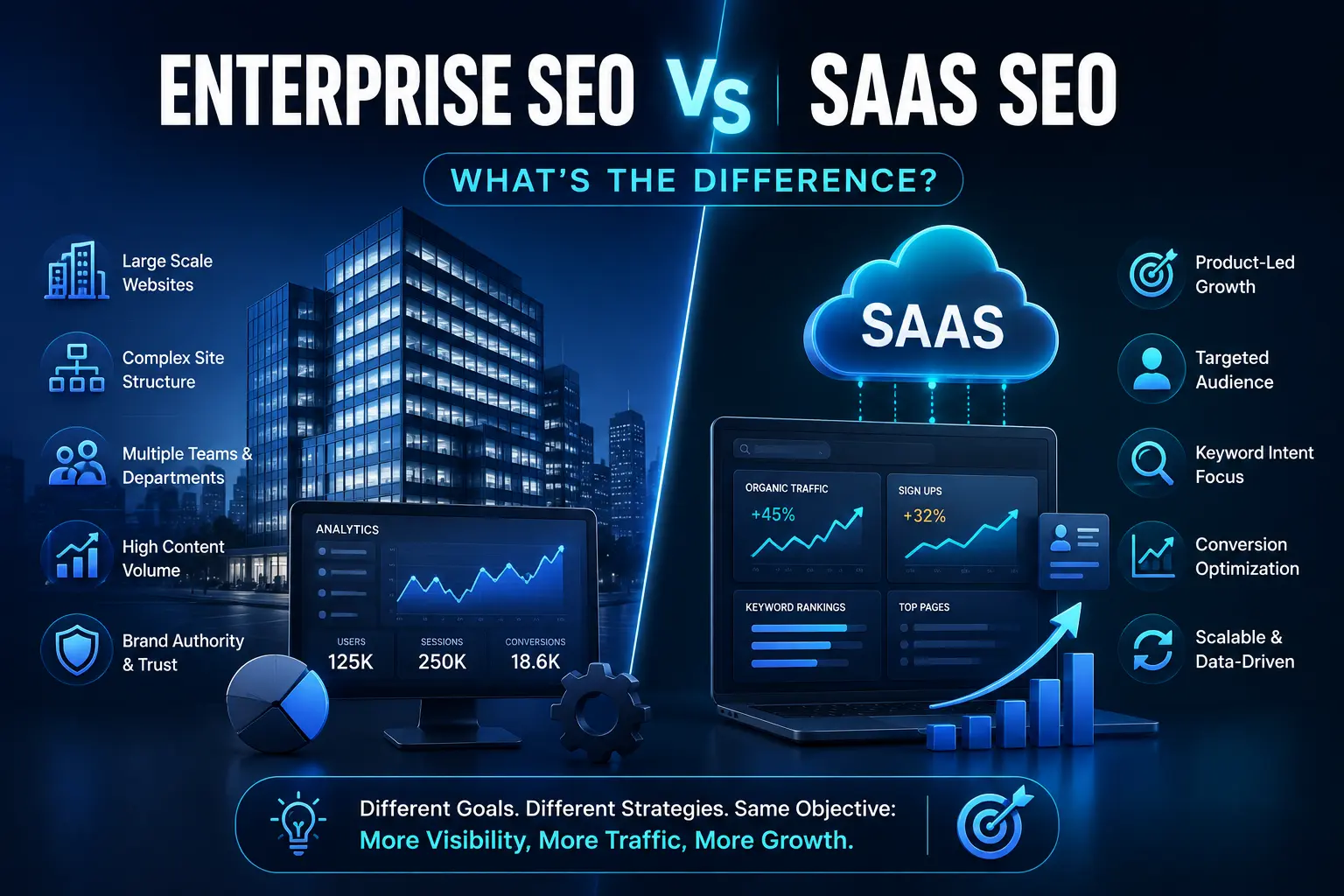
- Enterprise SEO deals with huge site architectures (thousands to millions of pages), multiple stakeholders, and slow-moving approval chains — the core challenge is scale and coordination.
- SaaS SEO is narrower in page count but has to fight for high-intent, often crowded commercial keywords (“best X software,” “X vs Y”) where competitors are equally agile.
- Enterprise SEO leans heavily on technical SEO — crawl budget, log file analysis, international/hreflang setups, and site migrations.
- SaaS SEO leans on comparison content, product-led landing pages, and bottom-of-funnel conversion keywords tied directly to trial signups or demos.
- The right approach depends on your site’s size and sales motion, not just your industry label — a large SaaS company with 500+ pages may need enterprise-style processes even without enterprise headcount.
What Is Enterprise SEO?
Enterprise SEO is what happens when your website is too big to manage by intuition. We’re talking companies with multiple product lines, regional subsidiaries, and often a legal or compliance team that needs to approve copy changes. Think airlines, banks, big retailers, or global manufacturers.
The defining challenge isn’t finding keyword ideas — it’s execution at scale. A single template change might affect 200,000 pages. A broken canonical tag setup can quietly tank rankings across an entire subdomain before anyone notices. I’ve worked with teams where getting a meta description changed required three approvals and a two-week review cycle, simply because the page in question touched a regulated product category.
Core Priorities in Enterprise SEO
- Crawl budget management — making sure Googlebot spends its limited crawl allowance on pages that matter, not thin duplicate pages or forgotten filter URLs
- International SEO — hreflang implementation across dozens of country/language variants
- Site migrations — enterprise sites go through domain consolidations, replatforming, and rebrands far more often than smaller sites, and each one is a high-risk SEO event
- Structured data at scale — schema markup applied programmatically across huge catalogs, not hand-coded per page
- Cross-team coordination — SEO recommendations routed through legal, brand, dev, and regional marketing teams before anything ships
What Is SaaS SEO?
SaaS SEO is built around a much tighter, more competitive battlefield. Most SaaS sites don’t have thousands of pages — they might have 200 to 2,000. But every one of those pages is often fighting for the same handful of high-value, high-intent keywords that every competitor in the category also wants.
Search “project management software” or “best CRM for small business” and you’ll see the same five or six brands trading positions constantly, refreshing content, and building comparison pages against each other by name. That’s the SaaS SEO game — less about crawl budget, much more about winning specific, commercially loaded searches that lead straight to a trial signup or demo request.
Core Priorities in SaaS SEO
- Comparison and alternative pages — “[Your Product] vs [Competitor]” and “[Competitor] alternatives” pages are often some of the highest-converting content SaaS companies produce
- Product-led content — blog posts and landing pages built around specific use cases, integrations, or workflows the product solves
- Bottom-of-funnel keyword targeting — prioritizing keywords close to a buying decision over broad top-of-funnel traffic plays
- Free tool and calculator pages — many SaaS companies build free mini-tools related to their product to capture search traffic and links
- Fast iteration — SaaS teams can usually publish and test content in days, not weeks, since there’s rarely a legal review bottleneck
Key Differences Side by Side
| Factor | Enterprise SEO | SaaS SEO |
|---|---|---|
| Site size | Thousands to millions of pages | Hundreds to a few thousand pages |
| Main bottleneck | Approvals, technical scale, crawl budget | Competitive keyword saturation |
| Content focus | Category/product pages, localization | Comparison pages, use-case content, tools |
| Turnaround speed | Weeks to months per change | Days to weeks per change |
| Success metric | Organic revenue across regions/business units | Trial signups, demo requests, MRR influence |
| Technical demands | hreflang, log file analysis, migrations | Core Web Vitals, on-page optimization, schema for software |
Where the Two Actually Overlap
It’s not a clean split, though. A SaaS company that’s scaled past Series C — think a company like HubSpot or Notion in their growth phase — starts inheriting enterprise-style problems: huge blogs, help center documentation numbering in the thousands, multiple language versions. At that point, “SaaS SEO” and “enterprise SEO” aren’t really separate categories anymore; the SaaS company just becomes an enterprise site with a SaaS business model.
On the flip side, smaller enterprise divisions sometimes operate more like SaaS teams — a single product line within a big company might run its own agile content sprint, publishing comparison pages and interactive tools without touching the parent company’s broader technical SEO concerns.
So the honest answer is that “enterprise vs SaaS” is really a proxy for a different question: is your bottleneck scale and coordination, or is it competitive saturation on a smaller number of high-value keywords? Answer that, and you’ll know which playbook actually applies to you.
FAQs
Is enterprise SEO harder than SaaS SEO? Not harder, just different — enterprise SEO is harder to execute due to scale and approvals, while SaaS SEO is harder due to intense keyword competition on fewer, high-value terms.
Can a small SaaS company use enterprise SEO tactics? Some tactics like structured data and Core Web Vitals optimization apply universally, but full enterprise processes like multi-region hreflang usually aren’t needed until a SaaS company scales significantly.
What’s the biggest SEO priority for SaaS startups? Bottom-of-funnel content — comparison pages, alternative pages, and use-case content tied directly to trial or demo conversions — usually delivers the fastest ROI.
Do enterprise sites need SaaS-style content too? Yes, if the enterprise sells a product with a self-serve or trial component; many large companies now run smaller SaaS-style content teams within their broader SEO structure.
Final Takeaway
Don’t pick your SEO strategy based on your company’s label — pick it based on your actual bottleneck. If you’re drowning in pages, approvals, and technical debt, you need enterprise-style processes: crawl audits, structured data at scale, and tight cross-team workflows. If you’re fighting five competitors for the same twenty keywords, you need SaaS-style speed: sharper comparison content, faster publishing, and content tied directly to your funnel. Most companies land somewhere in between — the trick is knowing which problem you’re actually solving.