



Every brand posting Reels has felt this moment: the video’s ready, the caption’s written, your finger’s hovering over “Share” — and you genuinely don’t know if it’s going to land or die at 40 views. Post it anyway, and if it flops, that flop sits on your grid, visible to every follower and every potential customer scrolling your profile.
Instagram built a workaround for exactly this problem. It’s called Trial Reels, and most Perth businesses either haven’t heard of it or tried it once in 2024 and forgot it existed. That’s a mistake in 2026 — the feature has matured into something closer to a proper testing tool than the rough beta it launched as.
Here’s what it actually does, how it works today, and how a Perth-based brand should be using it.
What Is an Instagram Trial Reel?
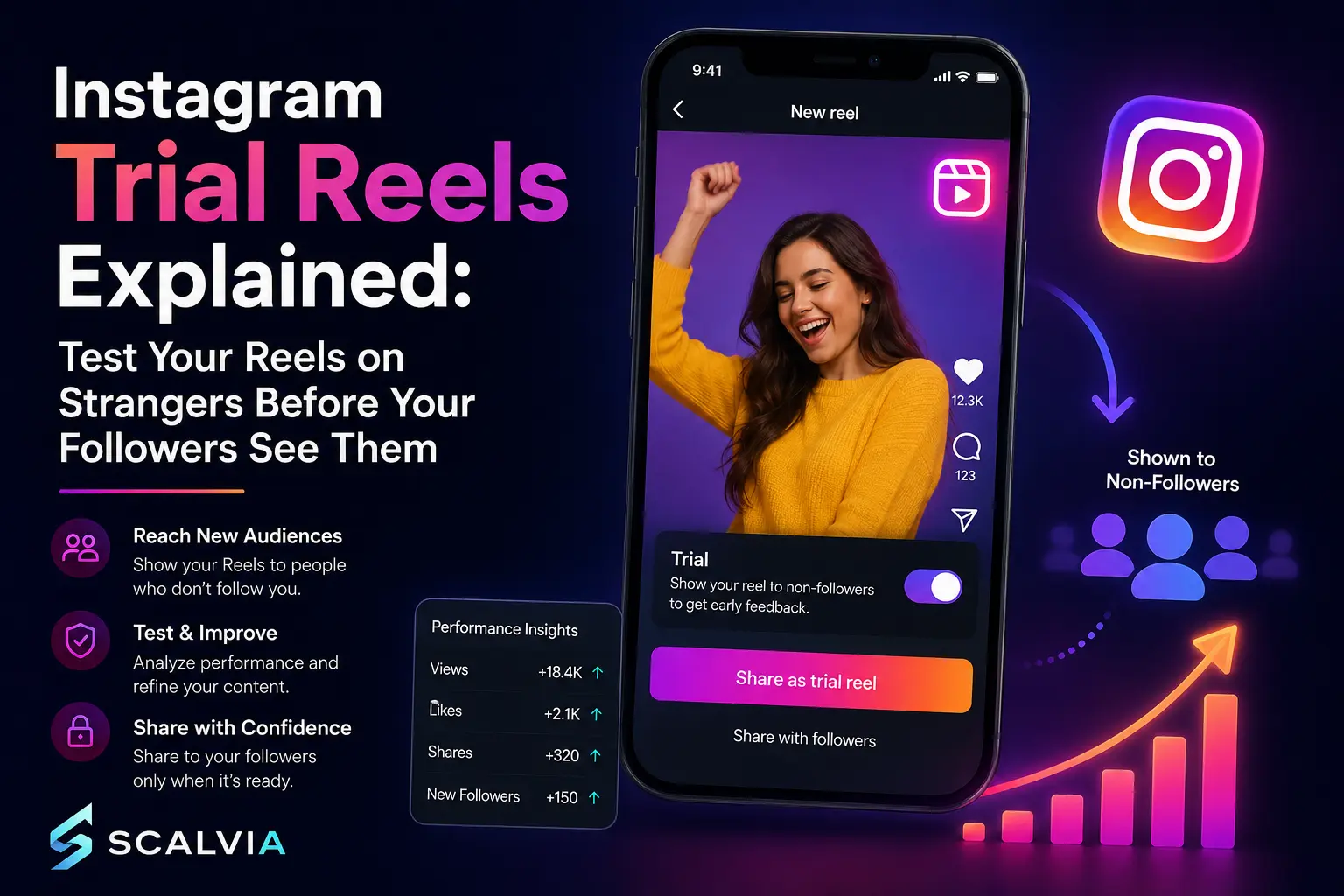
A Trial Reel is a version of your Reel that Instagram shows only to people who don’t already follow you. It doesn’t touch your grid, doesn’t appear to your existing audience, and doesn’t count toward your regular Reels metrics while it’s being tested.
In practical terms, it’s a way to run a live audience test before committing content to your permanent feed. Instead of guessing whether a hook, an audio track, or an idea will work, you get real engagement data from cold viewers — people with no reason to like or comment out of loyalty.
That distinction matters more than it sounds. Your existing followers are a biased sample. They already like your brand, so their engagement doesn’t tell you much about whether the content itself is strong. Non-followers have nothing invested — if they watch, share, or comment, that’s a genuine signal.
Why This Matters More in 2026 Than It Did at Launch
Trial Reels weren’t always worth building a strategy around. At launch, the test window was short, insights were thin, and access was patchy. That’s changed on a few fronts:
- Longer evaluation window. Trials now run for roughly three days instead of one, giving Instagram — and you — more time to gauge how content performs before deciding its fate.
- Scheduling support. You can now line up a Trial Reel to publish at a specific time, rather than only testing content the moment you finish editing it.
- Posting limits. Instagram caps how many trials you can run in a short window. Overdo it and you can lose trial access temporarily, which pushes brands toward more deliberate testing rather than spraying content at the wall.
- Better reporting. Instagram has shared performance data suggesting the feature meaningfully increases how far Reels travel among non-followers, and that creators who use it tend to post more consistently afterward — likely because they’re publishing with more confidence.
The net effect: Trial Reels went from “interesting experiment” to a legitimate part of a content workflow, particularly for brands that can’t afford to post duds to a feed they’ve spent years building.
Who Can Actually Use Trial Reels
Access isn’t universal. To see the option, you generally need:
| Requirement | Detail |
|---|---|
| Account type | Business or Creator account |
| Profile visibility | Public |
| Follower count | Roughly 1,000+ |
| App version | Recent version of Instagram |
If you meet these and still don’t see it, check the audience settings screen when uploading a Reel — it’s not always in an obvious spot, and Instagram has been rolling access out unevenly by region.
How to Set Up a Trial Reel
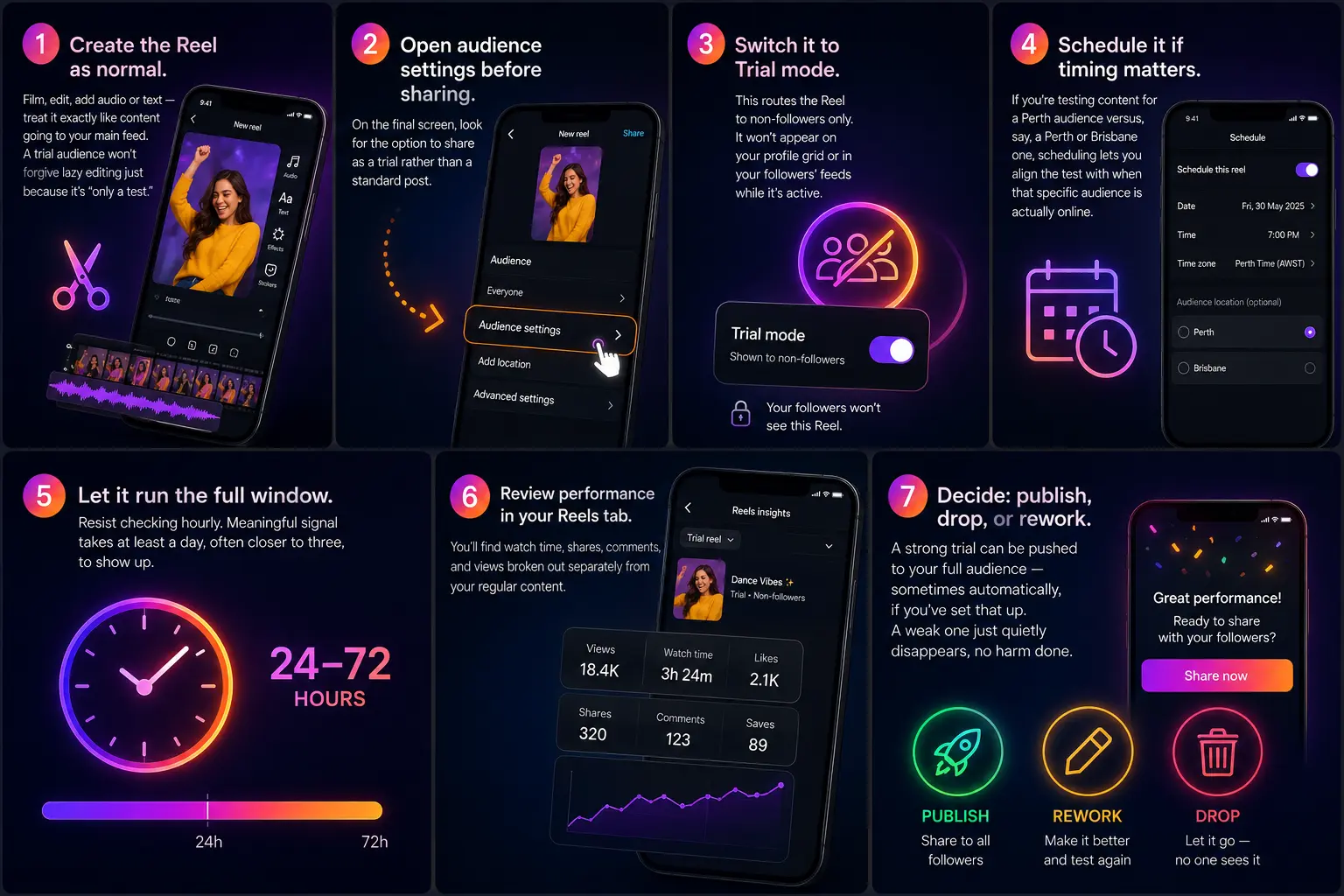
- Create the Reel as normal. Film, edit, add audio or text — treat it exactly like content going to your main feed. A trial audience won’t forgive lazy editing just because it’s “only a test.”
- Open audience settings before sharing. On the final screen, look for the option to share as a trial rather than a standard post.
- Switch it to Trial mode. This routes the Reel to non-followers only. It won’t appear on your profile grid or in your followers’ feeds while it’s active.
- Schedule it if timing matters. If you’re testing content for a Perth audience versus, say, a Perth or Brisbane one, scheduling lets you align the test with when that specific audience is actually online.
- Let it run the full window. Resist checking hourly. Meaningful signal takes at least a day, often closer to three, to show up.
- Review performance in your Reels tab. You’ll find watch time, shares, comments, and views broken out separately from your regular content.
- Decide: publish, drop, or rework. A strong trial can be pushed to your full audience — sometimes automatically, if you’ve set that up. A weak one just quietly disappears, no harm done.
What to Actually Look At (Not Just Views)
Views are the easiest number to fixate on and the least useful one on its own. For a trial to tell you anything, look at:
- Average watch time — did people stay, or bail in the first two seconds?
- Shares — the strongest signal that content resonated enough to pass on.
- Comments — particularly ones that aren’t just emojis; genuine reactions mean the content provoked something.
- Completion rate relative to views — a smaller but highly-engaged audience often beats a large, disengaged one.
A Reel with 800 views and an 80% completion rate is telling you something very different than one with 8,000 views and a 10% completion rate — even though the second number looks better on paper.
Where Trial Reels Fit Into a Real Content Strategy
Testing creative before paid spend. If you’re planning to put budget behind a Reel, running it as a trial first lets you validate the hook and format organically, before you’re paying to learn the same lesson through ad spend.
Reviving old content. A Reel that underperformed months ago isn’t necessarily bad content — it might have hit the algorithm on a bad day, or reached the wrong audience. Re-cutting the opening and running it as a trial gives it a genuine second chance.
De-risking a brand voice shift. Trying a bolder tone, a different format, or content outside your usual niche is exactly what trials are built for. If it doesn’t land, your regular audience never sees the miss.
What trials aren’t good for: bottom-of-funnel conversion content aimed at people who already know your brand, or as a substitute for a regular posting rhythm. If you’re already struggling to post consistently, trials add a step you don’t need yet — get the base habit down first.
A Simple Testing Framework for Perth Brands
Change one variable at a time, or you won’t know what actually moved the needle:
- Week 1: Test two versions of the same Reel with different opening hooks (question vs. bold statement).
- Week 2: Keep the winning hook, test two different audio tracks.
- Week 3: Keep the winning combination, test two different CTAs.
Over a few cycles, this builds an actual data set of what works for your specific audience, rather than relying on generic “best practice” advice that may not apply to your niche.
Frequently Asked Questions
Do Trial Reels affect my regular Instagram metrics?
No. Trial performance is tracked separately from your standard Reels analytics, and it doesn’t count against your engagement rate or reach numbers.
Can I turn a Trial Reel into a normal post?
Yes. Once the test window ends, you can choose to share it to your full audience, or set it to auto-publish if it crosses a performance threshold you’re happy with.
How long before I see results?
Early signal typically shows within the first day, with a fuller read forming over roughly three days.
Is there a downside to using Trial Reels a lot?
Yes — Instagram limits how many you can run in a short period. Treat them as a tool for higher-stakes content, not every single post.
Do I need a huge following to use this?
No, but you do need to clear a follower threshold (roughly 1,000) along with a public Business or Creator account.
The Bottom Line
Trial Reels solve a genuine problem: posting blind and hoping. For a Perth business balancing a small content team against a competitive local market, that’s not a minor convenience — it’s the difference between guessing what your audience wants and actually knowing.
If your content calendar is still built entirely on instinct, this is one of the easiest wins available on the platform right now. Test first, publish what’s proven, and let the guesswork go.
Want a Perth-based team that builds testing into your content strategy instead of just chasing whatever’s trending this week? Get in touch and let’s map out what that looks like for your brand.