



Introduction
SEO takes time because search engines need to discover, crawl, understand and evaluate your website before changes can translate into stronger search visibility. Some improvements may become visible within weeks, while meaningful growth in organic traffic and enquiries can take several months. Google confirms that changes can take anywhere from a few hours to several months to affect search results, and recommends allowing a few weeks to assess their impact. No agency can guarantee a specific ranking or deadline.
For Perth businesses and other Australian companies, the time required depends on the website’s current condition, competition, content quality, technical issues, local search visibility and how consistently SEO work is implemented. A new website competing in a crowded market will usually face a different challenge from an established business improving pages that already attract search traffic.
This guide explains what to expect during the first 30 days, the first three months, and the six-month period and beyond. It also covers how to measure progress, why SEO sometimes takes longer than expected, and what a professional SEO specialist should be doing while results develop.
Quick Answer: How Long Does SEO Take?
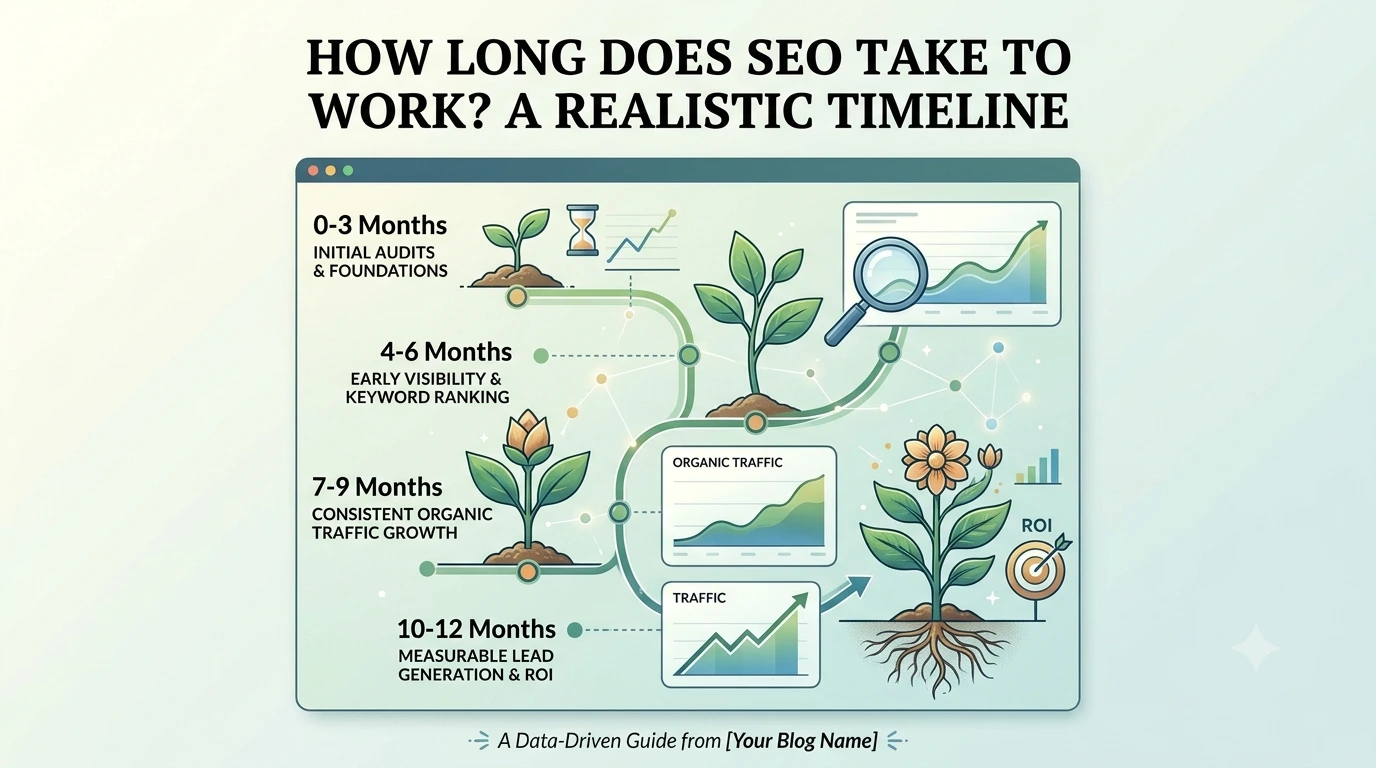
SEO does not have a fixed timeline. As a practical planning framework, many businesses use the following stages to assess progress. These are indicative milestones, not guaranteed ranking dates.
| SEO timeframe | What you may see |
|---|---|
| First 30 days | Website audit, keyword research, technical fixes, tracking setup and an initial SEO strategy |
| Months 2–3 | Improved pages and content being published, indexing progress and early ranking or impression changes |
| Months 3–6 | Potential growth in relevant keyword rankings, organic traffic and qualified enquiries |
| Months 6–12 | An opportunity to build on early gains, expand content coverage and improve performance in more competitive searches |
| Beyond 12 months | Continued optimisation, stronger topic coverage and efforts to maintain or improve visibility |
These stages can overlap. Some websites show progress sooner, while others need more time because of technical problems, strong competitors, limited resources or weak existing content. Google also makes clear that implementing SEO recommendations does not guarantee a noticeable improvement in search results. Google Search Central explains how to assess the effects of SEO changes.
1. Why Does SEO Take So Long?
SEO is not a single change that immediately moves a website to the top of Google. It is an ongoing process involving technical improvements, content development, search intent, website structure, authority and continuous performance analysis.
When you publish a page or update an existing one, Google must first discover and crawl it. The search engine then processes the page and may index it if it meets the relevant requirements. Ranking systems determine whether that page is suitable for particular searches.
Even after these steps, a page’s position can change as Google reassesses its relevance and usefulness alongside competing pages.
Google needs time to process website changes
Updating a page title, fixing a technical issue or publishing a new service page does not mean Google will immediately reflect the change in its results.
The time involved varies according to the website, the type of change and Google’s crawling and processing systems. Some changes are reflected relatively quickly; others take considerably longer. Google does not guarantee that every page will be crawled, indexed or shown for a particular query.
Competitors are working on their websites, too
Your business is not competing against a fixed list of websites. Other businesses may be improving their service pages, publishing useful content, earning relevant mentions and strengthening their online presence.
For example, a Perth plumber targeting a specific suburb may face a different level of competition from a national business targeting a highly competitive commercial keyword. The amount of work needed to become more visible will differ accordingly.
SEO requires several improvements to work together
A technically sound website may still struggle if its pages do not answer customers’ questions. Likewise, excellent content may not perform as well as it could if important pages are difficult to discover or the website has serious technical issues.
A successful SEO strategy therefore considers the whole customer journey, from the first Google search to the point where someone requests a quote, makes a booking or contacts the business.
2. A Realistic SEO Timeline: Month by Month
The following timeline illustrates how an SEO campaign may develop for a small or medium-sized business. Your actual milestones will depend on the website, competition and implementation speed.
Month 1: Audit, research and fixing the foundations
The first month is generally about understanding the website and identifying the most important opportunities.
A professional SEO specialist should assess the website’s existing performance before recommending changes. This includes reviewing technical health, relevant keywords, competitors, page quality and conversion paths.
Typical activities include:
- Conducting a technical SEO audit.
- Reviewing Google Search Console and analytics data, where available.
- Researching keywords and search intent.
- Identifying missing, duplicated or underperforming service pages.
- Reviewing page titles, headings, internal links and metadata.
- Checking indexability, redirects, broken links and sitemap configuration.
- Establishing baseline rankings, organic traffic and enquiries.
For a Perth business, this may also involve reviewing Google Business Profile information, service-area coverage and relevant local landing pages.
What should you expect?
You should be able to see a clear plan, prioritised recommendations and evidence of work completed. Rankings may not change significantly during this stage, especially when the website requires substantial technical or content improvements.
The absence of immediate ranking gains does not automatically mean that the campaign is failing. However, a lack of clear deliverables or progress reporting is worth discussing with your SEO provider.
Month 2: Implementing technical and on-page improvements
Once the initial research is complete, the next stage is implementing the changes most likely to improve the website’s search performance.
Depending on the audit findings, this could include improving important service pages, correcting crawl issues, refining page titles and headings, improving internal links or making the site easier to navigate.
Content work may also begin. A business could publish a detailed service page for a key offering or improve an existing article that attracts relevant search impressions but few clicks.
What should you expect?
Google may begin reflecting some changes during this period, although the timing varies. Search Console may show changes in impressions, queries or average positions.
These early signals are useful, but they are not proof that the campaign will achieve a particular level of traffic or sales. They should be interpreted alongside the quality and relevance of the searches being attracted.
Month 3: Monitoring early search visibility
By the third month, a campaign with consistent implementation may have enough data to identify early patterns.
For example, a local business might discover that several service pages are appearing for more relevant searches. Another website may see higher impressions but little change in clicks because its pages are still ranking below competitors.
The SEO specialist should investigate these patterns instead of treating every ranking movement as a success or failure.
Work during this stage may include:
- Reviewing changes in keyword visibility.
- Improving pages that receive impressions but few clicks.
- Publishing additional content around important customer questions.
- Strengthening internal links between related pages.
- Checking whether technical fixes have been implemented correctly.
- Identifying new opportunities from actual search queries.
What should you expect?
You may begin seeing early indicators of progress, but significant traffic or lead growth is not guaranteed by month three. A newer website or a business targeting highly competitive terms may need a longer runway.
Months 4–6: Building momentum
This is a useful period for assessing whether the campaign is moving in the right direction.
By now, more of the planned technical work and content improvements may have been implemented. Depending on the starting point, some pages may gain search visibility, organic traffic may increase, and relevant enquiries may begin to improve.
For a Perth electrician, progress might mean greater visibility for specific services in relevant suburbs. For an ecommerce store, it could mean more product and category pages attracting non-branded searches.
However, growth is rarely consistent across every keyword and page. Some pages may improve while others remain unchanged or lose visibility as competition and search results evolve.
What should you expect?
Your reporting should show more than a list of rankings. Look for changes in qualified organic traffic, the performance of priority pages, relevant enquiries and the relationship between SEO activity and business goals.
If progress is limited, the next step is to diagnose the problem. The answer might involve content quality, search intent, implementation delays, technical issues or an overly competitive keyword strategy.
Months 6–12: Expanding and refining the strategy
For many businesses, the second half of the first year is an opportunity to build on earlier improvements rather than start from scratch.
The SEO team can use performance data to decide which pages deserve further optimisation, which content gaps remain and where the business has a realistic opportunity to compete.
Activities may include:
- Expanding successful topic clusters.
- Improving service and location pages that attract relevant impressions.
- Updating older content where it no longer meets search intent.
- Strengthening internal linking and site architecture.
- Earning relevant, editorially justified links and mentions.
- Improving landing pages to turn more visitors into enquiries.
- Reviewing the return on SEO investment.
What should you expect?
The aim is to develop a more effective and sustainable source of relevant organic traffic. Competitive markets can take longer, and results may fluctuate. SEO should remain an ongoing process of measurement and improvement rather than a campaign that automatically ends after six months.
3. What Affects How Quickly SEO Works?
Two businesses can invest in SEO for the same period and see very different outcomes. Several factors explain why.
Website age and existing search visibility
A new website usually has less historical performance data and fewer established pages than a business website that has been online for years.
An established website may already have useful content, relevant links and pages that Google understands. Improving those assets can sometimes be more straightforward than building visibility from the ground up.
Nevertheless, an older domain does not automatically perform better. Website quality, relevance, technical condition and competition still matter.
Keyword competition
The difficulty of the target keywords can have a major effect on the timeline.
A business targeting a specific service in a defined local area may have a more achievable starting point than a company targeting a broad national keyword dominated by established websites.
For example, compare these searches:
- “Emergency electrician in Joondalup”
- “Electrician”
- “Best accounting software”
- “Accounting software for small construction businesses”
These searches differ in intent, audience and competitive landscape. More specific terms can be useful opportunities, but they are not automatically easy to rank for. Keyword research should assess actual search behaviour and the quality of competing results.
Technical SEO issues
Technical problems can prevent search engines from accessing, understanding or indexing important pages.
Examples include:
- Important pages accidentally blocked from crawling.
- Incorrect canonical tags.
- Broken internal links or redirect chains.
- Duplicate or very similar pages competing for visibility.
- Poor site architecture.
- Mobile usability or page performance issues that affect the user experience.
Not every technical issue has the same importance. A professional audit should prioritise problems that affect important pages or prevent search engines from processing the site effectively.
Content quality and search intent
Content must meet the needs of the person searching.
A page that repeats keywords without explaining the service, answering questions or helping visitors make a decision is unlikely to be a strong long-term asset. Search engines aim to surface useful, relevant content, so businesses should focus on originality, accuracy, clarity and genuine customer value.
For example, a page targeting “SEO services Perth” should explain what the service involves, who it is suitable for, what the process includes and how a business can evaluate an SEO provider.
Adding more words alone does not guarantee better rankings.
Website authority and relevant links
Links from relevant, credible websites can help search engines discover pages and understand relationships between sites. A website with a stronger existing reputation may have advantages over a new website with little external recognition.
Building a useful online reputation takes time. Focus on legitimate mentions, relevant partnerships, valuable resources and editorially earned links rather than buying manipulative links or using automated link schemes.
How quickly recommendations are implemented
Even a well-researched SEO strategy cannot deliver its intended benefits if important changes remain unimplemented.
If a developer takes several weeks to fix an indexing problem, or a business delays publishing its core service pages, the campaign’s progress may slow. Clear responsibilities and timely decisions help prevent avoidable delays.
Budget and consistency
Budget can affect how much work is possible each month, including technical development, content production, digital PR and ongoing optimisation.
A larger budget does not guarantee faster rankings. What matters is whether the resources are allocated to the right problems and implemented effectively.
4. How Long Does SEO Take for Different Types of Businesses?
The type of business influences the strategy, the competition and the milestones worth tracking. The following comparisons are planning guidance, not fixed industry averages.
| Business type | Main SEO priorities | What can affect the timeline? |
|---|---|---|
| Local service businesses | Google Business Profile, service pages, local relevance and reviews | Local competition, location coverage and website condition |
| Tradies | Service-specific pages, suburb relevance and quote enquiries | Competition from established providers and directories |
| Professional services | Detailed service pages, expertise and trust signals | Competition, credibility and the complexity of customer decisions |
| Ecommerce businesses | Product and category pages, technical SEO and product information | Site size, duplicate content, product competition and development resources |
| New websites | Indexability, site structure, useful content and initial visibility | Lack of existing search presence and external recognition |
| Established websites | Improving underperforming pages and expanding successful topics | Technical debt, outdated content and changes in search demand |
| National businesses | Topic coverage, competitive content and broader authority | Large competitors, multiple markets and resource requirements |
Local SEO for Perth businesses
Local SEO can be particularly important for businesses whose customers come from specific suburbs or service areas.
A plumber, dentist, accountant or cleaning company may need to improve its Google Business Profile, create helpful service pages, maintain consistent business information and make it easy for customers to enquire.
The timeline will depend on local competition, the business’s existing presence and the relevance of its website and profile to the searches being targeted. No single optimisation guarantees placement in the Google Maps results.
SEO for small businesses
Small businesses do not necessarily need to compete for every broad keyword.
A more focused strategy may prioritise the services that generate the most value, the locations the business can genuinely serve and the questions customers ask before contacting a provider.
This approach helps businesses direct limited resources towards meaningful opportunities. It still requires research, consistent implementation and realistic expectations.
Ecommerce SEO
An online store may have hundreds or thousands of URLs, making technical structure and content management especially important.
Product availability, category organisation, filtering parameters, duplicate pages and product descriptions can all influence the work required. In addition, organic traffic must be assessed alongside product engagement and sales rather than treated as the final objective.
5. How Can You Tell Whether SEO Is Working?
Waiting for a first-page ranking is not the only way to evaluate an SEO campaign. Several indicators can reveal whether the website is moving in a useful direction.
Track impressions and clicks
Google Search Console helps you review how often pages appear in Google Search, which queries trigger those appearances and how many clicks they receive.
An increase in relevant impressions can be an early sign that a page is appearing for more searches. Clicks may follow as visibility improves, but the relationship is not automatic.
Monitor keyword rankings
Keyword tracking can show whether priority search terms are improving, declining or remaining stable.
Use rankings as a diagnostic measure rather than the only success metric. A number-one position for an irrelevant term may have little business value, while a lower position for a highly relevant search could still contribute to enquiries.
Measure qualified organic traffic
Analytics tools can help you understand how visitors arriving through organic search behave on the website.
Look at the pages they visit, whether they engage with useful content and whether they complete meaningful actions. An increase in traffic is more valuable when it brings the right audience.
Track enquiries and conversions
For most service businesses, the commercial objective is not simply more visitors. It is more relevant phone calls, contact form submissions, quote requests, bookings or sales.
Set up appropriate conversion tracking where possible, and compare performance over consistent periods. Account for seasonal demand and other marketing activities that may influence the results.
Review the work completed
Performance data should be paired with a record of what the SEO team actually implemented.
Monthly reporting may cover:
- Technical fixes completed.
- Pages optimised or published.
- Changes in impressions, clicks and priority rankings.
- Organic enquiries or sales, where tracking is available.
- Problems identified and the next actions planned.
Google’s guidance recommends allowing a few weeks to assess the effect of changes. For broader improvements, the evaluation period may be much longer.
6. Why Might SEO Results Be Taking Longer Than Expected?
If your website has received SEO attention for several months but performance remains flat, investigate the cause before simply increasing the budget or changing agencies.
The website has unresolved technical problems
Important pages may be blocked, incorrectly canonicalised, missing from the internal link structure or difficult to access. Confirm that the pages you want to rank can be crawled and indexed.
The content does not match what people want
A page may target the right keyword but answer the wrong question. Someone searching for a service provider may need pricing information, evidence of expertise and a clear next step, rather than a general article that never explains the service.
Review the search results and the actual needs of the intended audience before rewriting the page.
The keywords are too competitive
Targeting only broad, highly competitive keywords can make early progress difficult, particularly for newer websites.
Review the keyword mix and consider whether more specific service, location or problem-focused queries are relevant to the business. Do not select keywords solely because they appear easy; they still need to attract potential customers.
SEO recommendations are not being implemented
An audit is only useful if its important findings lead to action. Delayed development, missing content approvals or a lack of ownership can leave the campaign stuck in planning.
Agree on priorities, responsibilities and deadlines with your SEO provider.
Reporting focuses on activity instead of outcomes
Publishing articles or building links does not automatically prove that a campaign is effective.
Reports should connect activities to the website’s search visibility and business objectives. If performance is not improving, the provider should explain what the data suggests and how the strategy will change.
The business expects guaranteed rankings
Google’s search results are dynamic, and no SEO provider controls every factor that affects them. Promises of guaranteed first-page rankings by a fixed date should be treated cautiously.
A credible provider should explain what it plans to do, how progress will be measured and what could affect the outcome.
7. How Can You Improve Your SEO Timeline?
Although no business can control every aspect of Google Search, it can reduce avoidable delays and improve the quality of its SEO work.
Start with the highest-impact issues
Prioritise problems that prevent important pages from being crawled, indexed or understood. Next, focus on service pages and other content that directly supports business objectives.
Avoid spending time on minor cosmetic changes while major technical or content problems remain unresolved.
Target realistic keywords
Use keyword research to understand search intent, competition and commercial relevance.
For a local business, specific service and location searches may offer a sensible starting point. Broader terms can remain part of the long-term strategy as the website develops.
Improve existing pages before publishing endlessly
New content is not always the answer. Some existing pages may already receive impressions and need clearer titles, more useful information, stronger internal links or a better conversion path.
Review performance data to decide whether to improve an existing page, create a new one or consolidate overlapping content.
Create useful content consistently
Build content around genuine customer questions and decisions. For example, an SEO agency in Perth could publish material explaining local SEO, SEO pricing, the SEO audit process and the difference between SEO and Google Ads.
Each article should have a clear purpose and link naturally to relevant service pages where appropriate. Avoid producing near-identical pages for every suburb or keyword without offering distinct value.
Improve the conversion experience
SEO brings potential customers to your website, but the site must make it easy for them to take the next step.
Use clear service descriptions, useful evidence of credibility, mobile-friendly layouts and straightforward enquiry options. A website that attracts traffic but makes contacting the business difficult may not deliver the commercial value expected from SEO.
Review results and adjust the strategy
Use Search Console, analytics and enquiry data to identify what is working. Continue investing in useful opportunities, investigate underperforming pages and change priorities when the evidence supports doing so.
This is more effective than following a fixed checklist indefinitely without evaluating the outcome.
8. What Should an SEO Agency Do During the First Six Months?
When you hire an SEO agency, you should understand what it will work on, how the priorities are selected and how the results will be evaluated.
The exact schedule will vary, but a sensible process generally includes the following.
Month 1: Research and planning
- Audit the website and establish baseline performance.
- Research priority keywords and search intent.
- Review competitors and the business’s target market.
- Identify technical, content and local SEO opportunities.
- Agree on objectives, reporting metrics and priorities.
Months 2–3: Implementation
- Fix priority technical issues.
- Improve important service and landing pages.
- Publish or refresh content where justified.
- Improve internal linking and website structure.
- Review indexing and early search performance.
Months 4–6: Evaluation and refinement
- Assess ranking, impression and click trends.
- Identify pages with promising or declining performance.
- Expand content based on search demand and business priorities.
- Improve conversion paths and lead tracking.
- Set the next priorities based on evidence.
This schedule is a framework rather than a universal prescription. A website with severe technical problems may need more foundational work, while an established site may be ready to focus on content expansion and competitive opportunities sooner.
For businesses considering SEO services in Perth, the important question is not simply how many tasks an agency completes. It is whether those tasks address the right problems and support measurable business objectives.
9. Is SEO Worth the Wait for Small Businesses?
SEO can be worthwhile for small businesses that want to attract people actively searching for their services, products or expertise. However, its suitability depends on the business model, customer demand, competition, budget and ability to wait for organic visibility to develop.
Unlike paid advertising, organic search traffic does not require paying for every click. Nevertheless, SEO is not free: research, content, development, technical maintenance and ongoing optimisation all require time or money.
A practical approach is to consider SEO alongside other marketing channels.
For example, a new Perth business may use Google Ads to test demand and attract enquiries while building its organic search presence. Over time, SEO can support a broader mix of acquisition channels, although neither channel guarantees a particular number of leads.
Before committing to a campaign, clarify:
- Which services or products matter most commercially?
- What searches are likely to attract qualified customers?
- How competitive is the market?
- What technical and content work is required?
- How will calls, enquiries and sales be tracked?
- What level of investment is sustainable over several months?
The objective is to make informed decisions based on the business’s circumstances, rather than expecting immediate results from a long-term strategy.
10. Frequently Asked Questions
How long does SEO take to show results?
Some changes can affect search results within days or weeks, while others take several months. Early signs may include changes in impressions, indexing or keyword visibility. Meaningful growth in traffic and enquiries depends on the website, competition and work implemented.
Can SEO work in 30 days?
Yes, SEO work can be implemented within 30 days, and some changes may be reflected in search results during that period. However, 30 days is generally too short to judge the full impact of a broader campaign. Use the first month to establish a baseline, fix priority issues and begin measuring progress.
Why does SEO take three to six months?
Three to six months is often used as a practical planning window because SEO involves implementation, crawling, indexing, competition and ongoing evaluation. It is not a universal Google guarantee or a deadline by which every website should improve.
Can a new website rank on Google quickly?
A new website can appear in Google Search after its pages are discovered and indexed, but indexing does not guarantee strong rankings. A new site may need time to establish useful content, relevance and credibility, particularly in competitive markets.
Does local SEO work faster than regular SEO?
Local SEO can produce different patterns of progress because it focuses on location-related searches and local business visibility. A business with a complete, relevant online presence in a less competitive area may find opportunities sooner, but results depend on the market and other local ranking factors.
How many months should I pay for SEO?
There is no universal minimum period that guarantees results. SEO often requires several months of consistent work to evaluate broader outcomes, so businesses should assess the strategy, deliverables and progress over a realistic period. Review the contract, reporting and cancellation terms before signing.
Should I stop SEO if rankings do not improve after three months?
Not automatically. First, review whether the planned work has been completed, whether important pages are indexed, whether impressions and relevant queries are changing, and whether the keyword targets are realistic. If there is little evidence of progress, ask the provider for a specific diagnosis and revised action plan.
Can an SEO agency guarantee first-page rankings?
No agency can reliably guarantee a specific Google ranking by a fixed date. Search results are influenced by systems and competitors outside the agency’s control. A credible provider should set realistic objectives, explain its work and report performance transparently.
How do I measure SEO success if rankings are still low?
Track early indicators such as indexation, impressions, relevant search queries, page performance and completed optimisation work. Also monitor qualified traffic and conversions where possible. These measures help you assess whether the campaign is building useful visibility, even before substantial ranking gains occur.
Final Thoughts: Give SEO Time, but Expect Evidence of Progress
SEO is a long-term investment, but that does not mean businesses should wait indefinitely without knowing what their provider is doing.
A realistic approach starts with a clear audit, prioritises the most important technical and content improvements, tracks meaningful metrics and adjusts the strategy as evidence becomes available. Some changes can be reflected quickly, while competitive rankings and sustainable organic growth may take considerably longer.
For Perth businesses and companies across Australia, the best SEO timeline is one that matches the website’s starting point, the competitive landscape and the outcomes the business wants to achieve.
If you’re considering professional help, explore Scalvia’s Perth SEO services to learn how a tailored SEO strategy can support your website’s visibility and business goals.